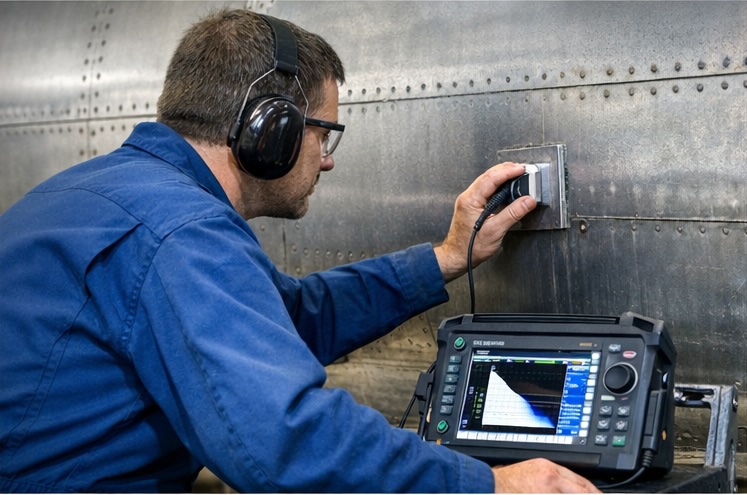
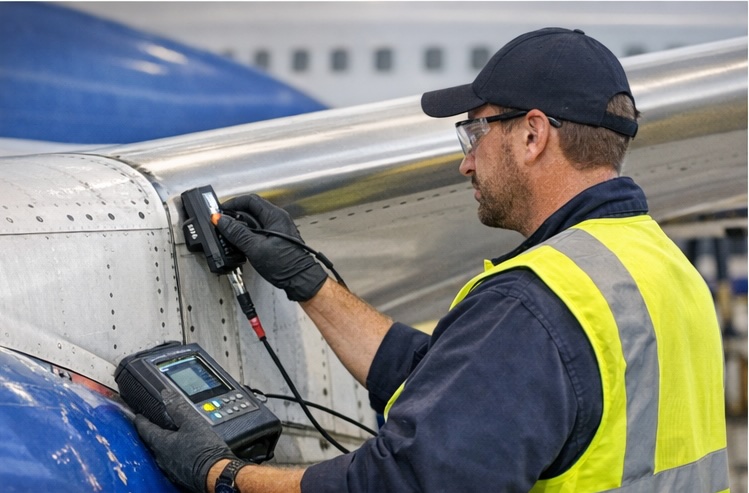
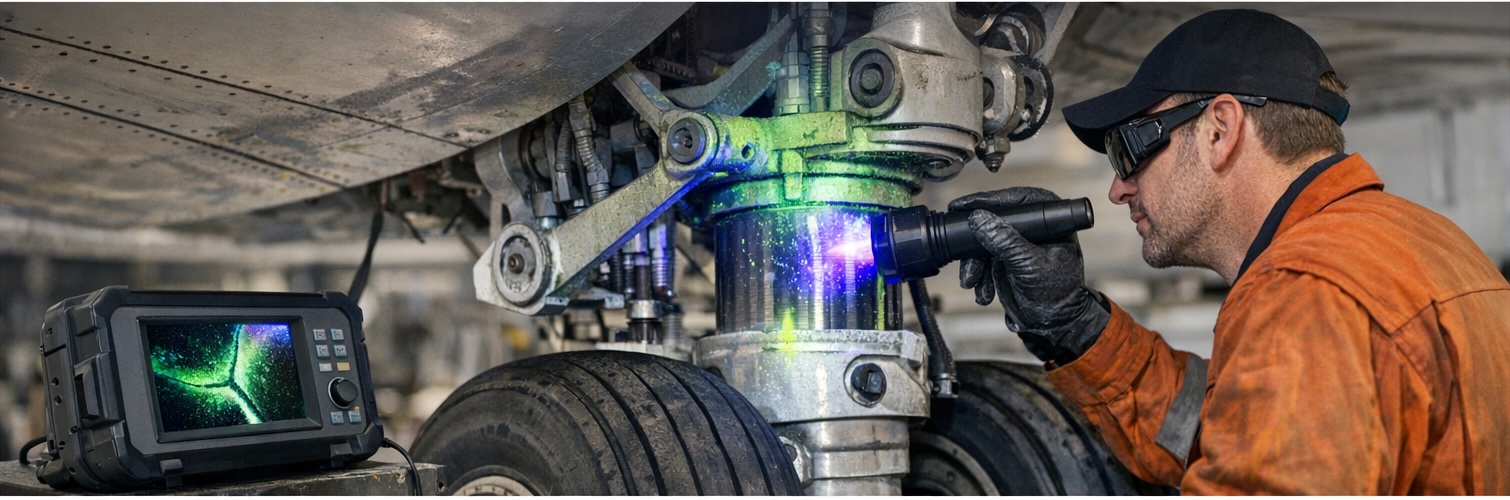
Non-Destructive Testing and Evaluation (NDT&E) is one of the major requirements related to the complete lifecycle of aerostructures. Almost all the components have to pass through various Non-Destructive Testing (NDT) quality assurance procedures and need to be inspected by NDT at defined intervals. For damage tolerant design used in aviation, NDT is a prerequisite. Appropriate use of NDT guarantees safety in aerospace and is thus a subject of highest attention.
Although aerospace industries have to clearly stick to certified NDT procedures, there is a large amount of technology being currently developed within the engineering science discipline, which is worth discussions with respect to their application potential. The widespread use of emerging materials such as CFRP composites or ceramics as well as new manufacturing processes for aerospace structural components such as additive manufacturing has also given rise to many new questions regarding the materials reliability and manufacturing methods in the light of NDT&E, from a research as well as a manufacturing and assembly and maintenance point of view.
To communicate latest R&D achievements to industrial applicants on the one hand, to discuss advanced and improved methods and to understand the needs for inspection and maintenance both with scientists as well as industrial researchers on the other the International Symposium for NDT in Aerospace (AeroNDT) was established in 2008 and has been organised on a nearly annual basis since 2010. It is run in places worldwide where aerospace has a home including Hamburg/ Germany, Montreal/ Canada, Augsburg/ Germany, Singapore, Madrid/ Spain, Bremen/Germany, Bengaluru/India, Xiamen/China, Dresden/Germany, Paris/France, Williamsburg/ USA and Busan/ South Korea so far.
The 15th edition of this symposium Aero NDT 2026 is now to be held at the HITEX Exhibition Centre in Hyderabad/India between November 14 and 17, 2026 jointly with NDE-2026. The main theme of this joint conference is Aerospace and Defence. This is a unique opportunity for attendees, exhibitors and speakers, because a community of 1500+ attendees is addressed and 100+ exhibitors can be visited with all their technology being presented verbally and in hardware. A strong focus will be laid on Aerospace Certification and Digital Transformation jointly run as special sessions between AeroNDT2026 and NDE 2026. A highlight of the symposium is also technical visits to aerospace and defence related industries in the Hyderabad area focussing specifically on their interests in NDT/NDE.
HiTEX Exhibition Centre, Hyderabad, India
Dates: 14–17 November 2026
Venue details and map can be obtained from isntnde.in/venue.
Hotel accommodation details will be updated soon.
The programme is mainly split into three tracks divided again into two parts each where part 1 consists of invited papers and part 2 of contributed papers respectively. In detail this looks as follows:
As AI/ML moves into structural inspection and monitoring, the aviation industry faces a fundamental question: What does it take to trust a learned system in a certified, safety-critical domain? This Part 1, delivered in a tutorial style by invited speakers, lays out the foundations for elaborating on that question. It introduces the essential AI/ML concepts, the governing standards, and the certification framework that make reliable, trustworthy AI/ML-based structural inspection possible. This part will be structured as follows:
This part of this topical track builds on the foundations laid in Part 1, turning to real-world technology and experience with AI/ML in aerospace inspection and structural health monitoring (SHM). Researchers, practitioners, and regulators working across this field are invited to submit abstracts for oral and poster presentations. Contributions may address but are not limited to the following topics:
These topics are intended as a guidance rather than a fixed set. Submissions that address related challenges in bringing AI/ML into reliable, certifiable aerospace inspection are equally welcome.
The Digital Twin has moved, within a decade, from a NASA-and-USAF aspiration to a documented industrial architecture with an agreed vocabulary, published reference models, and a regulatory pathway for earning maintenance credit. The corresponding shift in non-destructive evaluation is that inspection is no longer a periodic pass-or-fail activity but a continuous information stream feeding an asset's digital representation. Realising that shift requires competences that rarely sit in one organisation: the materials physics that determines what a defect does, the inspection and sensing physics that determines what can be seen, the reduced-order and multifidelity modelling that makes real-time inference tractable, the enterprise architecture that preserves identity from as-designed to as-measured, the probabilistic machinery that propagates model, parameter and measurement uncertainty into a prognosis, and the standards and certification work without which none of it may be relied upon in service. This part will be structured as follows:
This part of this topical track builds on the foundations laid in Part 1, turning to real-world technology and experience with digital twins and digital threads in design, integration, reliability and NDE. Researchers, practitioners, and regulators working across this field are invited to submit abstracts for oral and poster presentations. Contributions may address but are not limited to the following topics:
These topics are intended as a guidance rather than a fixed set. Submissions that address related challenges in bringing digital twins and digital threads into reliable, certifiable aerospace inspection are equally welcome.
Over the last three decades, aerospace NDT personnel qualification and employer certification and authorisation, have evolved into highly structured frameworks, governed by requirements stated in NAS 410 and EN 4179 standards, reinforced through Nadcap accreditation, and enforced via FAA/EASA airworthiness regulation and OEM-specific qualification requirements. In the meantime, emerging technologies such as additive manufacturing, advanced composites, digital inspection, automation, robotics, structural health monitoring and AI-assisted inspection are creating new challenges for qualification, certification and accreditation systems. This part will be examining how existing certification frameworks must evolve to address future inspection requirements while maintaining the highest levels of airworthiness and public safety. It brings together international experts from regulatory agencies, aerospace OEMs, accreditation bodies and certification organizations to review the global landscape and discuss the next generation of aerospace NDT accreditation and certification frameworks.
Talks within Part 1 will include but may not be limited to the following:
Rapid growth in commercial aviation, indigenous defence programmes, unmanned systems, aircraft maintenance and repair activities, private aerospace manufacturing, and the expanding space sector are creating unprecedented demand for highly qualified aerospace NDT personnel in India. Reliable and standardized inspection capabilities to ensure airworthiness and mission safety are therefore in need. While India has a well-established NDT community through the Indian Society for Non-destructive Testing (ISNT) and recognized certification schemes under ISO 9712, the country presently lacks a National Aerospace NDT Board (NANDTB) of the kind referenced by EASA and NAS410/EN4179-aligned frameworks. Such Indian NANDTB is intended to support the ecosystem already in place, overseeing aerospace-specific qualification and examination requirements, determining equivalence (including specifying which elements of existing ISO 9712 certification can be recognized as prior evidence, and what additional aerospace-specific examinations, experience and employer authorization would remain necessary), setting requirements for emerging inspection methods, and approving training and examination organizations. This session will bring together key stakeholders from civil aviation, military airworthiness, aerospace manufacturing, certification bodies and the aerospace industry to discuss the opportunities, challenges and roadmap for establishing a NANDTB.
Talks within Part 2 will include but may not be limited to the following:
From Need to Design: What Indian NANDTB Model Can Earn Regulatory, Industry and International Recognition? (tentative title)
Moderator: Track Chairs
Panelists: DGCA, CEMILAC/DGAQA, Civil MRO or Major Aerospace Supplier's Representative, Prime Contractor / Type-Certificate Holder's Responsible Level 3, ISNT, Aerospace Industry Representatives
Researchers, scientists, technologists, and industry professionals are warmly invited to submit original and unpublished work for presentation at NDE-2026 and AeroNDT 2026. Contributions are welcome across the suggested technical themes as well as in other emerging and interdisciplinary areas relevant to Non-Destructive Evaluation for aerospace application.
Registering for NDE-2026 including AeroNDT 2026 offers a comprehensive experience that blends cutting-edge technical knowledge, networking opportunities, and professional development.
| Category | National (Before Aug 31, 2026) | National (After Aug 31, 2026) | International (Before Aug 31, 2026) | International (After Aug 31, 2026) |
|---|---|---|---|---|
| ISNT Member | 15,000 ₹ | 19,000 ₹ | 40,000 ₹ | 40,000 ₹ |
| Non-Member | 20,000 ₹ | 24,000 ₹ | 40,000 ₹ | 40,000 ₹ |
All fees + 18% GST
Over 100 exhibitors and aerospace facility visits.
Please visit isntnde.in/exhibitorCategory to book your stall.
Prof. Christian Boller – c.boller@mx.uni-saarland.de
Prof. Srinivasan Gopalakrishnan – krishnan@iisc.ac.in